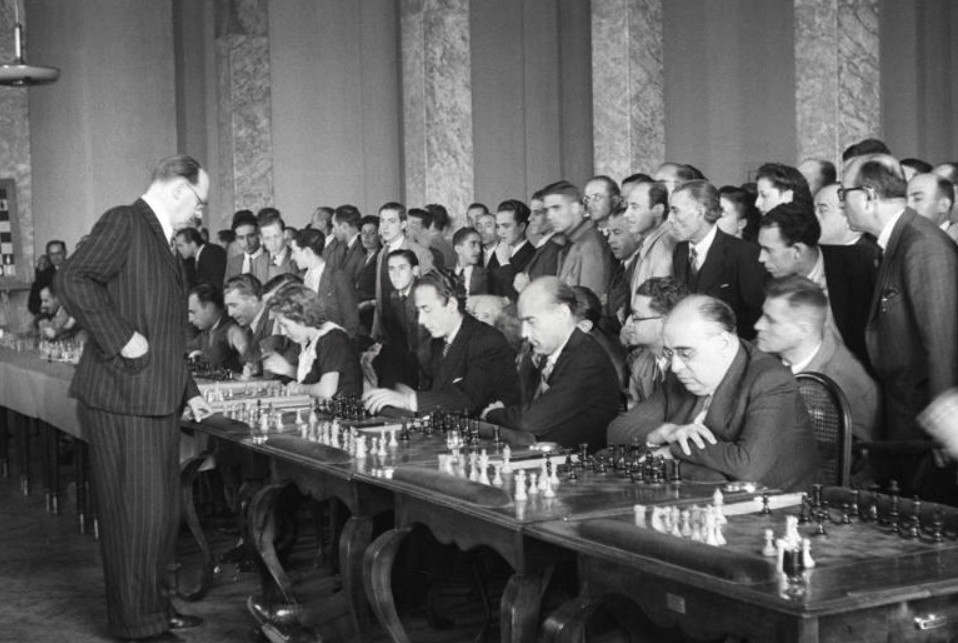
Warning: preg_match_all() expects parameter 2 to be string, object given in /home/web/winterchess.com/pomar/classes/class.general.php on line 174 Simultànies d´Alekhine Madrid 1943
Madrid
Del 15/10/1943 al 18/10/1943
Arturito Pomar a l´altra banda del tauler
El 15 d'octubre de 1943 en el Cercle de Belles Arts de Madrid, el campió del món d'escacs, Alexander Alekhine, s'enfronta a 30 partides simultànies durant el gran torneig internacional d'escacs en el Cercle de Belles Arts. Aconseguint un resultat de 23 partides guanyades, 2 empatades i 5 perdudes.
Estava previst que Alehine participés en el torneig internacional de Madrid, però va arribar amb retard i no ho va poder fer. Per a compensar-ho va donar aquesta sessió de simultànies davant jugadors de Madrid que no van participar en el torneig. Els organitzadors van calcular que unes 5000 persones havien estat veient l'exhibició durant la tarda.
Tres dies després, Alekhine jugarà vuit partides simultànies d'escacs amb rellotge durant el gran torneig internacional d'escacs en el Cercle de Belles Arts. Un dels vuit contrincants és Arturito Pomar.
Els rivals foren Alonso Leira, Eugenio Gómez, Pomar, Gutiérrez de Soto, Cifuentes, Ortueta, Kocher y Gómez Acebo. Aconseguint un resultat de +5=3-0, fent taules davant Gómez, Alonso i Gutiérrez de Soto. El control de temps establert fou de 16 jugades per hora, i la durada de la sessió s'allargà cinc hores.
Partides
[Event "Madrid sim"]
[Site "Madrid"]
[Date "1943.11.18"]
[Round "?"]
[White "Alekhine, Alexander"]
[Black "Pomar Salamanca, Arturo"]
[Result "1-0"]
[ECO "C21"]
[Annotator "Davies, Nigel"]
[PlyCount "61"]
[EventDate "1943.??.??"]
[EventType "simul"]
[EventCountry "ESP"]
1. e4 e5 2. d4 (2. Nf3 Nc6 3. d4 exd4 4. c3 dxc3 5. Nxc3 Bb4 6. Bc4 Bxc3+ 7.
bxc3 {is the comparable Goering Gambit line.}) 2... exd4 3. c3 dxc3 4. Nxc3 Bb4
{Aiming to take the wind out of White's sails by capturing the knight on c3.
This works quite well in the Goering Gambit line above. Does White do better
without the moves Nf3 and ...Nc6 inserted?} ({The other reasonable way to
develop Black's bishop is with} 4... Bc5 {; for example,} 5. Bc4 d6 ({instead,
} 5... Qf6 6. Nf3 Ne7 7. O-O Nbc6 {was Alekhine-Rozanov & Simson (consulting),
Moscow 1917, and now} 8. Nd5 Nxd5 9. exd5 Ne7 10. Bg5 Qxb2 11. Rb1 Qa3 12. Qe2
{seems best, with serious problems for Black}) ({, and} 5... Nc6 {is downright
bad because of} 6. Bxf7+ Kxf7 7. Qh5+ {establishing material equality but with
Black unable to castle, a line that can also be reached via 4...Nc6 5 Bc4 Bc5})
6. Nf3 ({I don't like} 6. Qb3 {because of} Qh4) 6... Nc6 (6... Nf6 7. e5 Qe7 8.
O-O dxe5 9. Nxe5 O-O 10. Re1 {gives White a strong initiative}) 7. Qb3 Qd7 ({
White can meet} 7... Qe7 {with} 8. O-O Nf6 9. Bg5 {threatening 10 Nd5}) 8. Nd5
Nge7 9. Qc3 f6 10. O-O Ne5 11. Nxe5 fxe5 12. Be3 Nxd5 13. Bxd5 {was very
awkward for Black in Penrose-A.Green, British Championship, Plymouth 1957, as
the game is opening up with Black's king unable to castle.}) 5. Bc4 ({Mueller
and Voigt mention the possibility of} 5. Qd4 $5 Bxc3+ 6. Qxc3 Nf6 7. e5 Qe7 8.
Be2 {, but now} Ne4 {looks critical , for example} ({rather than their} 8...
Nd5 9. Qg3 O-O) 9. Qxc7 ({or} 9. Qd4 f5) 9... O-O 10. Nf3 Qb4+ 11. Nd2 Nc6 {
and Black's pieces are getting very active.}) 5... Bxc3+ {It's now or never if
Black wants to inflict some structural damage.} ({After} 5... Nc6 {I think
White should protect the knight on c3 with} 6. Nge2 {; for example,} d6 ({
other moves to have been tried are} 6... Ne5 7. Bb3 Nf6 8. O-O h6 9. f4 Bc5+
10. Kh1 Neg4 {as in Cogswell-Pitman, Boston 1905, and now} 11. e5 $1 {would
have been immensely strong}) (6... Nge7 7. O-O O-O 8. a3 Bxc3 9. Nxc3 d6 10. f4
Kh8 {was a game S.Trent-J.Lutton, London 1999, when} 11. f5 Ne5 12. Ba2 f6 13.
Qh5 {threatening 14 Rf4 would have given White a strong attack}) ({, and} 6...
Nf6 7. O-O O-O 8. a3 Bxc3 9. Nxc3 d6 10. Bg5 {threatened 11 Nd5 in Matoussi-El
Jihani, Algiers 2000}) 7. O-O Bxc3 (7... Nf6 8. Nd5 Nxd5 $2 9. exd5 Ne5 10.
Qa4+ {won a piece in Regan Neal-Ford, Berkeley 1991}) 8. Nxc3 Nf6 9. Bg5 h6 10.
Bh4 O-O 11. f4 {left Black facing a very unpleasant pin on his f6-knight in
Firnhaber-Huels, correspondence 1992.}) 6. bxc3 d6 {Probably the most solid,
though there are again alternatives:} (6... Qf6 7. Qb3 Nh6 8. Nf3 O-O 9. O-O
Re8 10. e5 Qf5 11. Bxh6 gxh6 12. Nh4 Qh5 13. f4 d5 14. Bxd5 Be6 15. Bxe6 fxe6
16. Qxb7 {and White won quickly in B.Wall-Latell, Mount View 1986.}) (6... Nf6
7. e5 Qe7 ({or} 7... Ne4 8. Qg4 Nxc3 9. Qxg7 Rf8 10. Bg5 {1-0 B.Wall-Tanker,
Internet 2001}) 8. Qe2 Ng8 9. Nf3 Nc6 10. O-O f6 11. Re1 {left Black
hopelessly behind in development in I.Fernandez-J.Sanchez, Juvenil 1998.}) (
6... Qe7 {is probably best met by} 7. Ne2 Nf6 8. O-O Nc6 9. Bg5 d6 10. f3 {
when White's two bishops, mobile kingside pawns and annoying pin on the knight
offer him good compensation for the pawn.}) (6... Nc6 7. Ne2 Nf6 8. O-O O-O ({
if} 8... Nxe4 9. Bxf7+ Kxf7 10. Qd5+) 9. f3 d6 10. Bg5 {and here, too, White
has compensation because of his bishop pair, mobile kingside pawns and the pin
on f6.}) 7. Qb3 ({Another move worth considering here is} 7. Ne2 {; for
example,} Nc6 8. O-O Nf6 9. f3 O-O 10. Bg5 {offers compensation as in the
notes with 6...Qe7 and 6...Nc6 above.}) 7... Qe7 8. Ne2 Nc6 9. O-O Nf6 10. Nd4
Nxd4 $6 {Giving White a couple of nice central pawns and ironing out the
defects in his structure.} (10... O-O {looks better, after which} 11. Nxc6 bxc6
12. f3 {offers White ongoing compensation.}) 11. cxd4 O-O ({Black can't take
the e4-pawn, as after} 11... Nxe4 12. Re1 Kd8 13. f3 Nc5 14. Qb4 a5 15. Qd2 Ne6
16. d5 {White wins a piece.}) ({And} 11... Qxe4 12. Bxf7+ Kd8 13. Bb2 {would
leave Black's king too exposed.}) 12. Re1 ({The immediate} 12. e5 {was also
worth considering, for example} Ne8 (12... dxe5 $2 13. Ba3) 13. Ba3 Qh4 14.
Rad1 {with excellent compensation.}) 12... h6 ({It seems tempting to try and
exchange pieces with} 12... Be6 {, but after} 13. d5 Bc8 14. Bb2 Ng4 15. Qg3 {
White would have a magnificent attacking position.}) 13. Ba3 Ng4 $2 {A
decisive loss of time.} (13... Nh7 {may be the best chance, though Black's
position is admittedly rather bad after} 14. e5 Re8 15. f4 {etc.}) 14. f3 Nf6
15. e5 Nd7 16. exd6 Qf6 17. dxc7 Qxd4+ 18. Kh1 Nc5 19. Bxf7+ $1 {The start of
a nice finish. Alekhine was pretty good when it came to attacking, even in
simuls.} Rxf7 (19... Kh8 20. Qd5 Qf4 21. Bg6 {would have been pretty horrible
for Black too.}) 20. Bxc5 Qf6 21. Rad1 b6 22. Rd6 Qf5 23. Rd5 Qf6 24. Be7 $1
Rxe7 25. Rxe7 Kf8 26. Re1 Bb7 27. Rd7 Bc6 28. Qb4+ Kg8 29. Rd6 Qf8 30. Qc4+ Kh8
31. Qxc6 1-0